Tuesday, May 31, 2011

Symbolic Debt Limit Vote Fails..


The debate over whether to raise the US debt and how it should be raised have been the main focus of discussion in Washington D.C. as of late and today that debate went to a new level..sort of.


Today a vote was held in the U.S. House of Representatives to raise the Debt Limit from its current level of $14.294 trillion to $16.7 trillion with no corresponding cuts. The vote, a GOP introduced bill mind you, got only 97 "yay" votes all of which were Democrats. The vote was clearly symbolic in nature, designed to put Democrats on the stop about the issue and to try and strengthen the GOP's resolve on the issue.


The debate lately has revolved not necessarily IF the debt ceiling should be raised, but HOW it should be raised. The GOP has not set out a firm figure of how much cuts they want in exchange for agreeing to raise the debt ceiling but it is a great enough number that various reports state the GOP and Democrats are "trillions apart".


Add to that the argument made by many Democrats and the President that raising the debt ceiling is more important than how it is done and such massive cuts being asked by the GOP are holding the nation's credit hostage. However most Democrats do seem to agree that cuts will need to be made, the issue is they don't see them as being that important.


But they are dead wrong. They attempts to shift the blame to the GOP and that they are holding the US economy hostage are rather predictable and pathetic. Now most economists I have read over the last few months do agree raising the debt ceiling is necessarily and not doing so could cause a financial panic. However raising the debt ceiling with no corresponding cuts could be equally damaging in the long run.


This lack of urgency about cuts from the Democrats is not very surprising to political wonks and everyday people alike. Many Democrats belong to the camp that believes that the way to fix an ailing economy is to pump more money into it, often citing FDR's efforts during the Great Depression. However as recent history has shown, throwing money at the problem is only making the problem worse, not so much because of the amount of money used by HOW the money is used. Many of the programs Democrats support have good intentions but how they are carried out leaves the everyday man scratching his head.


So considering the looming debt that rises everyday here in the U.S., it only makes sense that if the US government plans to increase the very limit of US debt (a rather humorous idea in the first place), then it should be willing to "trim its waistline" to at the very least slow the accumulation of debt.


Now how much should be made in cuts and where such cuts should be made is something I can't answer but if the Democrats, and the President, are truly interested in dealing with the US debt problem they will need to be pretty flexible with the GOP instead of wasting their time and OUR money accusing the GOP of holding the economy hostage..I know calls for bipartisanship are often met with cynical looks and eye rolls but that doesn't change that fact that some kind of compromise is necessary..God forbid our elected representatives behave as adults!

Thursday, May 26, 2011

Poll: Mitt Romney has broadest support among Republicans

By DAN HIRSCHHORN 5/26/11 6:20 PM EDT Updated: 5/26/11 6:27 PM EDT

Mitt Romney is the candidate who'll be able to build a Republican coalition, but no one does better than Sarah Palin on connecting with GOP voters on social issues, according to a new Gallup poll.

Romney wins support from a wide swath of Republicans, pulling 16-18 percent regardless of whether their most important issues are government spending, the economy, national security or moral values. Palin has even stronger support among Republicans who put a premium on moral values — 23 percent of them back the former Alaska governor — but that's about the only segment of the electorate that picks her.

The poll also found former Godfather's Pizza executive Herman Cain outperforming Tim Pawlenty among all constituencies.

Government spending and power remains the most important issue for Republicans, with 36 percent identifying it as their key concern. Business and the economy follow at 31 percent, and only 15 percent of Republicans pick social issues as their most important, according to the poll.

The national survey of 971 Republicans and Republican-leaning independents, conducted May 20-24, has a sampling error of plus or minus 4 percentage points.

http://www.politico.com/news/stories/0511/55805.html

My Thoughts..

This is not terribly surprising to me personally. While Romney's past political actions do seem to keep coming back to haunt him, he is the arguably the only Republican candidate currently who appeals to a majority of Republican voters. And also not shockingly, Sarah Palin is the favorite of Social Conservatives in the GOP but doesn't score well with the party as a whole. However what should not be assumed from this poll is that Romney is what many conservatives today call RINOs (Republicans In Name Only), though mark my words if Sarah Palin does run she will call him one. The man is political creature, in that when he was governor of Massachusetts he approved of what are considered liberal policies, and when he ran for President he moved a bit more to the right to appeal to the broader base of the GOP. Now whether there is something wrong with that or not is a matter of opinion. Personally such tactics are what I expect from modern American politicians and make some good sense (see Senator Scott Brown for a good comparison). It shows to me that Romney is fairly flexible which I think is a good thing for a Presidental candidate.

Now for those who haven't heard, Sarah Palin is making two big moves that are making it look very much like she is going to run for President. First, it became known that she collaberated with a conservative moviemaker to produce a film to tell the "real" story about Sarah Palin that will premier here in Iowa later this year. Secondly, she is now planning a trip across the nation, the first such move since her book was published. In my opinion, these moves (especially the movie) are designed to try and "reintroduce" Sarah Palin to America and to put her rather troubling quitting of the governorship in Alaska in the past.

As such, I am going to make a rather bold prediction..I believe the time of the Iowa Caucus early next year, these two will be the primary candidates for the GOP. Also, I guarantee the Republican primaries will get very messy and probably quite bloody. You thought the Democratic primaries were bloody, just wait til 2012..Mark my words.

Wednesday, May 25, 2011

MSNBC suspends Schultz


Via POLITICO

MSNBC suspends Schultz for calling Ingraham a 'slut'

MSNBC has suspended Ed Schultz for one week without pay for calling Laura Ingraham a ‘right-wing slut’ on his radio program Tuesday.

“Remarks of this nature are unacceptable and will not be tolerated,” MSNBC said in a statement Wednesday evening.

Schultz will address the remarks on his television show Wednesday night, and begin his leave immediately afterward, MSNBC said.

"MSNBC management met with Ed Schultz this afternoon and accepted his offer to take one week of unpaid leave for the remarks he made yesterday on his radio program," MSNBC said.

The Daily Caller first noted the epithet in the midst of Schultz's critique of Ingraham’s criticisms of the president’s trip to Ireland.

“And what do the Republicans thinking about?” Schultz said. “They’re not thinking about their next-door neighbor. They’re just thinking about how much this is going to cost. President Obama is going to be visiting Joplin, Mo., on Sunday but you know what they’re talking about, like this right-wing slut, what’s her name?, Laura Ingraham? Yeah, she’s a talk slut. You see, she was, back in the day, praising President Reagan when he was drinking a beer overseas. But now that Obama’s doing it, they’re working him over.”

Ingraham reponded via her Facebook page on Wednesday.

“Re. the crude comments made about me by Ed Schultz on his radio program: First, I was surprised to learn that Ed Schultz actually hosted a radio show. Is it only available online?” she wrote. “ Second, I have to get back to recording the audio edition of my new book "Of Thee I Zing." Now I'm tempted to insert one additional zing--about men who preach civility but practice misogyny.”

Feminists, not normally ones to line up behind conservative talk radio hosts, were outraged at the comment. The Women’s Media Center, the nonprofit founded by Jane Fonda and Gloria Steinem, sent out an alert urging MSNBC to suspend Schultz.

“While conservative bloggers and watchdog organizations are highlighting Schultz’s remark, the Women’s Media Center also calls on MSNBC to suspend Schultz for his comments, since they not only attack Ingraham, but all women,” the group wrote in an alert Wednesday, according the Daily Caller. “Ms. Ingraham is no friend to the Women’s Media Center, but a sexist and misogynist attack based on her gender and not her political views or comments is harmful to women in media, politics, and beyond.”


Personally, I don't like Ed Schultz simply because I don't find his show on MSNBC very enlightening and the man is just too angry about everything. Not to mention he is a hardcore Liberal and I am, needless to say, am not. This kind of language from Schultz is not really surprising but it is completely and wholly unnecessary. I may not like Ms. Ingraham's opinions on certain things and she does annoy me at times, there is no justification for such language. I myself occasionally call people "twits" but this not because I disagree with them so much as I think they have no clue what they are talking about. I know Ms. Ingraham generally knows what she is talking about, I just don't agree with it. As such, Schultz very much deserves this punishment and should be rather ashamed of himself for stooping to such a level. The question is, do you really think he is sorry? I think not.

Five Medicare Lessons from NY-26 Election: POLITICO

By DAVID NATHER 5/25/11 4:44 PM EDT

Who would’ve thunk it? One party calls for changing the Medicare program to save money, the other party crushes them at the polls.

Democrat Kathy Hochul’s big win in the New York special election Tuesday proved that voters are not, in fact, rewarding Republicans for political bravery in backing Paul Ryan’s Medicare plan. But then, they didn’t reward Democrats in 2010 for passing a health care reform law with about $500 billion in Medicare savings, either.

And yet, neither side can just leave Medicare alone forever, if they want to make an actual dent in the deficit. So here are five lessons they can learn from the New York election for the next round:

Don’t propose things that change the game for everyone. Ryan’s plan would switch everyone into a new Medicare “premium support” program — subsidizing private insurance, rather than covering seniors directly — starting in 2022. Republicans insisted that anyone age 55 or older wouldn’t be affected, but everyone else would have to go into those plans.

And Democrats have been arguing that even current seniors would lose out under the plan, because new Medicare benefits under the health care reform law — such as beefed-up prescription drug coverage and annual wellness visits — would be repealed.

Under other versions of the Medicare premium support plan — like the bipartisan deficit proposal by former Sen. Pete Domenici and former Office of Management and Budget director Alice Rivlin — seniors can go into Medicare premium support if they want, but they can also stay in traditional Medicare if they want. Making it a choice, rather than a requirement, might make Medicare premium support a bit less scary to seniors. And there are other bipartisan ideas that leave Medicare the way it is but get money out of milder changes, like making seniors pay higher cost-sharing.

Stick to bipartisan deficit plans for political cover. The deficit commission headed by Alan Simpson and Erskine Bowles is the most well-known example, but there are others, like the Domenici-Rivlin plan. Any idea pulled from one of those plans — like higher cost-sharing for seniors — gives either Republicans or Democrats an instant political shield that can at least limit the damage. By choosing a mandatory Medicare premium support program, Ryan didn’t have that kind of cover.

Think about how it can be distorted. Political operatives from both sides are supposed to do this, but if they have, it hasn’t stopped their bosses from charging ahead. Fairly or unfairly, Democrats have been able to call the House Medicare proposal a “plan to end Medicare” because it would fundamentally change the structure of the program.

And fairly or unfairly, Republicans were able to attack Democrats last year for “cutting Medicare” because the health reform law gets about $500 billion in savings out of slowing payment increases to providers and Medicare Advantage plans. (Ryan’s plan keeps those savings, by the way.) Lesson: If your political opponent can make your plan sound that scary, think twice about it.

Pay attention to the polls. It’s not that House Republicans weren’t warned; GOP pollsters gave them plenty of warnings about the political dangers of the Ryan plan before they voted on it. Likewise, by the time Democrats took the final vote on health care reform in March 2010, they had had months of polls showing how unpopular the plan had become since the August 2009 town halls. They just decided the opposition would fade once the public learned more about the law — a prediction that, for the most part, hasn’t come true.

If you fire, the other side will probably fire back. Republicans won big with seniors in 2010 by attacking Democrats over the reform law’s Medicare cuts. How predictable was it that, this year, Democrats would attack Republicans if they put out a plan with Medicare cuts? About as predictable as politics can get.

And likewise, now that the Democrats have gotten so much mileage out of beating up on the Ryan plan — a process that will continue with the upcoming Senate vote on it — expect a sharper Republican attack against any Medicare savings plan the Democrats put out on their own. That includes Obama’s deficit reduction plan, which strengthens the Independent Payment Advisory Board, the reform law’s panel of experts who are supposed to propose more Medicare savings. Speaking on "Morning Joe" Wednesday, Ryan called it a “rationing board.” Other Republicans may be tempted to step up their attacks on “unelected bureaucrats” making medical decisions.

And that’s how the cycle will go, until one party or the other proposes a cease-fire on Medicare — which isn’t likely now until, say, 2013.

“Yes, we will be giving our political adversaries things to use against us in the next election, and shame on them if they do that,” Ryan said in April shortly before he unveiled the budget plan. But there’s plenty of shame to go around — and the biggest lesson of the N.Y. 26 race may be that shame doesn’t work as a political strategy.

http://www.politico.com/news/stories/0511/55701.html

My Thoughts..

The election in NY-26 last night was, contrary to GOP statements, something of a major event. To start, the district in question has traditionally been a solid Republican area and considered a "safe bet". Then suddenly, the Democratic challenger, Kathy Hochul (a political nobody apparently) and the third party candidate, Jack Davis changed the tone of the race dramatically.

The third party candidate, Jack Davis, is arguably a winner in the election even though he didn't actually win. His victory was over the Republican party for which he was a member for most of his life until he apparently had a falling out with the party over him wishing to question former VP Dick Cheney about free trade issues. He then tried several times to challenge the GOP for the NY-26 seat running as an independent and even as a Democrat occasionally. However this year he chose to run as a Tea Party candidate against the incumbent Jane Corwin. He's main political view during the election was neither party is taking the threat from China seriously and the US free trade practices need radical change. For his efforts, he succeeded in getting some 9% of the vote, most of which would probably have gone to the GOP candidate.

But the star of the show is definitely Democrat Kathy Hochul, though calling her a "star" is something of a stretch. Ms. Hochul was something of a political nobody before the election, with her experience including being a practicing attorney and legislative aide. Combine that with the fact she is not the typical Democrat in that she stated she supported major cuts to the federal government to deal with the deficit, being largely pro-life (though not to the same degree as her fellow candidates), and opposing new and existing free trade agreements. However she does support "ObamaCare" and does not support Congressman Paul Ryan's proposal of changing Medicare which she made her primary issue.

And that was the elephant in the room of this election. There was a good deal of mud-throwing over Mr. Ryan's proposal for reforming Medicare, with the Democratic candidate using the plan (which is generally disliked according to most national polls) to beat over the GOP's head. So much so that Charles Krauthammer stated on Fox's O'Reilly Factor the other night that it was likely the election would be decided because of the "MediScare" threat.

But as many commentators have pointed out, Special Elections are not the best gauge for making political predictions. While it does make it clear the Ryan Plan does worry some and Democrats are likely to take advantage of that worry and try to make it a major issue next year. Strikingly, former President Bill Clinton today commented that while he was happy the Democrats won the seat, he did not want Democrats to copy this strategy for next year's election because of the problem of trying to scare people about the issue (hence Krauthammer's reference to MediScare).

So yes, this special election showed that the Ryan Plan is becoming something of a problem for the GOP and if they want the plan to become reality they will need to launch a major counter attack to convince voters their plan is better than the alternative. However, focusing on this single issue will not bring Democrats back to power and could possibly backfire in the long term as voters become more irritated with talk of Medicare instead of talking about fixing the economy.

Personally, I have not made up my mind on the Paul Ryan Budget proposal. To deny it is a radical plan is pretty hard but radical change will be necessary to fix the looming budget crisis. I like Bill Clinton, don't necessarily love the plan but so far I have see no real alternatives from the Democrats and many aspects of Ryan's plan are appealing to me. Regardless, the plan deserves to be studied and debated openly and publicly and not demonized for short term political gains.

Sunday, May 22, 2011

Mitch Daniels won't run in 2012- POLITICO


By MAGGIE HABERMAN & JENNIFER EPSTEIN 5/22/11 1:31 AM EDT Updated: 5/22/11 7:21 AM EDT

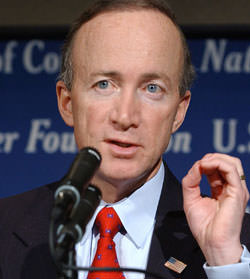
Indiana Gov. Mitch Daniels told supporters in an email early Sunday that he will not run for president in 2012, a decision he said ultimately came down to his family's reticence about a campaign.

The announcement by the former Office of Management and Budget director and favorite of much of the Republican establishment will again roil the unsettled GOP field—and likely intensify efforts to convince another major candidate to join the race, such as former Florida Gov. Jeb Bush or New Jersey Gov. Chris Christie.

"The following is from Governor Mitch Daniels…." the email began.

“I hope this reaches you before the public news does," Daniels wrote. "If so, please respect my confidence for the short time until I can make it known to all."

"The counsel and encouragement I received from important citizens like you caused me to think very deeply about becoming a national candidate. In the end, I was able to resolve every competing consideration but one, but that, the interests and wishes of my family, is the most important consideration of all. If I have disappointed you, I will always be sorry."

Daniels, who had deep fundraising ties from his time in the Bush administration and his own years in Washington, went on: "If you feel that this was a non-courageous or unpatriotic decision, I understand and will not attempt to persuade you otherwise. I only hope that you will accept my sincerity in the judgment I reached," he wrote.

"Many thanks for your help and input during this period of reflection. Please stay in touch if you see ways in which an obscure Midwestern governor might make a constructive contribution to the rebuilding of our economy and our Republic.”

The email, which went to a list of supporters but not the Indiana GOP's broader email list, was unusual —pols who bow out of campaigns rarely choose to announce it just after midnight on a Saturday.

But it was a reminder that Daniels has always tended to march to the beat of his own political drum, keep his own counsel and do things his own way.

Daniels's wife, Cheri, was widely known to be concerned about the impact a campaign would have on their lives, which have followed an unusual path. Cheri Daniels left her husband and their four young daughters in 1993, married a former sweetheart in California, then returned and remarried Daniels - a set of circumstances that the pair would be unable to avoid talking about in the crucible of a campaign.


In a statement to the Indianapolis Star about his decision, he highlighted the role his family played in his decision. "On matters affecting us all, our family constitution gives a veto to the women’s caucus, and there is no override provision. Simply put, I find myself caught between two duties. I love my country; I love my family more," he said.

He also defended his wife to the paper, saying, "The notion that Cheri ever did or would ‘abandon’ her girls or parental duty is the reverse of the truth and absurd to anyone who knows her, as I do, to be the best mother any daughter ever had."

The decision by Daniels, which he stretched on for a month past the close of the Indiana legislative session, ends a season of dithering about his 2012 intentions. His Hamlet-of-the-Heartland contortions about whether to run, combined with public statements showing something less than a fire in the belly, had started to make even his supporters uncomfortable.

The late-night move ensures Daniels's decision will be the focus of the Sunday morning talk shows - as opposed to speculation about whether he would pull the trigger on a campaign.

It also comes as Daniels is set to make a return trip to Washington, D.C. on Wednesday to headline a fundraiser for the committee where he once served as a top staffer, the National Republican Senatorial Committee.

Daniels's departure from the race presents a challenge to Republican elites, many of whom are less than enthralled with the current choices in a field that includes Mitt Romney, Tim Pawlenty, Newt Gingrich, Rick Santorum, Herman Cain and, likely, Minnesota Rep. Michele Bachmann.

Former Utah Gov. Jon Huntsman, who's making his first New Hampshire sojourn and is being met with high hopes by some Republican leaders, is the latest likely entrant to the slow-forming race.

"Mitch Daniels will be missed in this presidential debate, but his message about the most immediate threat facing our nation -- this massive debt -- will not go unheard," said Huntsman in a statement to POLITICO early Sunday.

Indeed, Daniels's main call to arms was about fixing the nation's budget woes - he made a splash at the conservative confab CPAC in February when he described the United States' growing debt burden as the new "red menace."

In bowing out, Daniels joined Mike Huckabee and reality tv star and developer Donald Trump, both of whom announced they would not run in the past week. Mississippi Gov. Haley Barbour, a close Daniels friend who'd told the Indiana governor he should consider the race, also dropped out in recent weeks.

Daniels's decision would seem on the surface to benefit Pawlenty in Iowa, where he's looking to come in with solid numbers in the caucuses, and Huntsman in New Hampshire, where the former Utah governor is expected to play hard if he runs. But it also is ultimately positive for Romney, who is increasingly able to cast himself as a stronger frontrunner; his aides recently reported raising $10 million in a single fundraising "call day" from Nevada.


Still, a group of Iowa donors is set to travel to New Jersey on May 31 to meet with Gov. Chris Christie in the hopes of getting him to join the race.

Despite the build-up surrounding Daniels, he carried some baggage in a prospective campaign.

Daniels suggested last year that Republicans choose to focus on combating the country s fiscal problems before turning to issues like abortion and gay marriage. The next president, he said, would need to call for a “truce on the so-called social issues.”

The notion of a truce irked social conservatives, but attracted the attention of more moderate Republicans hoping for a candidate who could put on a good showing against President Barack Obama in 2012.

Nonetheless, in time, Daniels inched away from his proposal, by signing a bill into law earlier this month which imposed some of the nation s strictest restrictions on abortions and making Indiana the first state to stop funding Planned Parenthood.

Yet for many, Daniels figured as an ideal potential candidate: Despite his tenure as the George W. Bush's budget director, a post which Democrats would have used against him, he had budget-cutting chops of his own during two terms as Indiana's chief executive.

Daniels had made clear all along that there were really only five votes that mattered for him - his wife, and their four grown daughters.

Cheri Daniels’s reticence was well-documented. The governor told POLITICO in February that it was “safe to say” that she didn’t welcome the prospect of him running. In late March, she told the Indianapolis Star that if her husband ends up staying out of the race, the impact of a campaign on the family would “definitely be a reason.”

She shunned the spotlight for much of her husband's tenure. Her star turn at a state GOP dinner two weeks ago was, sources told POLITICO, something of a testing-the-waters appearance to see how she fared. She was well-received, but the appearance prompted a fresh round of news accounts and reporters' questions about their marital history.

Talking to reporters after the state GOP dinner, Cheri Daniels said that she wasn’t the only one in the family uncertain about agreeing to go under the microscope of a presidential campaign. "It’s not just me," she said. "I have four daughters and I have three sons-in-law and everybody has a voice.”


Speaking at the same event, her husband wasn’t much clearer about his plans. ”This whole business of running for national office I’m not saying I won’t do it,” he said. ”My friends know it’s never been any intention of mine. I’d like to go to some quiet place where nobody could find me. Like Al Gore’s cable network.”

Daniels, 62, is in his second term as Indiana governor. First elected in 2004 after spending two and a half years in the Bush administration as OMB director, Daniels built a reputation as a politician whose interests, first and foremost, are fiscal.

As governor, he worked to cut spending and balance the state’s budget, though at OMB he oversaw the shift from annual budget surpluses to a deficit of $400 billion as the Bush administration cut taxes and ramped up spending for the Iraq war.


Wednesday, May 18, 2011

Newt Gingrich Campaign Fights for Its Life: POLITICO


By ALEXANDER BURNS 5/18/11 4:26 AM EDT

Even his supporters predicted Newt Gingrich’s mouth might knock him out of the presidential race.

But no one thought it would happen before his first real campaign trip to Iowa.

Now, Gingrich is urgently struggling to convince the political class that his 2012 hopes aren’t dead, amid an unending barrage of Republican attacks over his comments on the House GOP’s proposed Medicare overhaul.

Gingrich finally seemed to realize the seriousness of his political plight Tuesday, when he held three conference calls, made a personal apology to House Budget Committee Chairman Paul Ryan and admitted in a Fox News appearance: “I made a mistake.”

“The fact is that I have supported what Ryan’s trying to do on the budget,” Gingrich told Greta Van Susteren. “The budget vote is one that I am happy to say I would have voted for.”

It’s not clear whether that course correction has come too late. Before Gingrich’s evening mea culpa, there were growing signs that his gaffe – undermining his own party by calling Ryan’s much-touted Medicare plan too “radical” to become law on NBC’s “Meet the Press” – had already dealt him a near-fatal blow.

For two days, his team seemed flat-footed in response to a spiraling political crisis. The chorus of voices criticizing the former House speaker has only grown louder, drawing in Republicans as prominent as House Majority Leader Eric Cantor and South Carolina Gov. Nikki Haley.

“Many have said now he’s finished,” Cantor said in a radio interview, stopping short of endorsing that analysis but calling Gingrich’s comments “a tremendous misspeak.”

Perhaps most tellingly, not a single prominent Republican has rallied to Gingrich’s defense – a testament to the regard in which Gingrich is held by much of the Beltway GOP establishment.

For a host of party leaders, Gingrich seems to have proven with astonishing speed that he deserves his reputation as an undisciplined, self-destructive, shoot-from-the-lip politician. His flair for provocative rhetoric, combined with his desire to make loftier political points, might make him too combustible for the presidential campaign trail.

“The problem for Newt is, this is exactly what everybody who has ever worked for or around him said was his basic problem,” said Rich Galen, the veteran Republican strategist and former Gingrich aide. “Sooner or later, I suspect, unfortunately, the campaign will collapse from the top because people are going to say, ‘I love him and he’s really smart, but he can’t be president.’”

The campaign, Galen added, is “close to being functionally over.”

Gingrich supporters object that it’s far too early to count him out. The former Georgia congressman has come back from the brink of political death before, and there’s still time for him to recover in the slow-starting presidential race.

The candidate himself sounded a defiant note on Fox Tuesday night, largely blaming the media for his woes and vowing not to participate in any more “gotcha games.” Gingrich also refused to answer a question about a POLITICO report that he and his wife, Callista, amassed up to $500,000 in debt at Tiffany’s.

“If it doesn’t relate to solving our problems, from now on my answer’s going to be, ‘I’m not commenting on it,’” Gingrich said. “I’m not playing Trivial Pursuit.”

Gingrich has faced questions about his stance on the Ryan budget during his trip this week to Iowa, where advisers expressed optimism that he’s persuading voters his remarks were taken out of context.


“Newt’s done a great job explaining, ‘Hey, Paul Ryan is a friend of mine. The budget he put together was’ – I think he used the word ‘courageous’ – ‘in getting out there and starting the conversation,’” said Craig Schoenfeld, an attorney and former George W. Bush organizer in the Gingrich camp. “Once folks have actually had a chance to question him, and then interact and hear more than you’re ever going to get in a 30-second sound bite, they say, ‘Ok, that makes sense.’”

Back in Washington, party leaders aren’t quite so convinced.

While Gingrich expressed regret for some of the language he used on “Meet the Press,” neither he nor his advisers backed away from his basic message about Ryan’s budget: it’s a political loser that’s dead on arrival in the Senate.

“In terms of the underlying advice, I think Newt Gingrich would love to help Paul Ryan get it done and I think Newt Gingrich is the only person who’s uniquely qualified, with a track record to get it done,” spokesman Rick Tyler said. “What we want to do is design a campaign that gets the country in a conversation, understanding what’s at stake and how to fix it.”

That attitude is bound to frustrate congressional Republicans, who are in no mood to take legislative advice from a man who launched a thousand Democratic attacks by casually dropping terms like “radical” and “right-wing social engineering.”

Gingrich vowed to call out any Democratic campaign commercial that “quotes what I said on Sunday,” but much of the damage is already done.

Republicans are already fretting about the prospect that backlash over Ryan’s budget could help cost them a special House election next week in New York. The Democratic Congressional Campaign Committee seized on Gingrich’s remarks in a flurry of press releases Tuesday saying that “even Newt Gingrich” believed Ryan’s plan was out of the mainstream.

To Republicans looking to protect their House majority and run as the party of fiscal responsibility in 2012, it’s an almost unpardonable offense to give that kind of ad copy to the opposition party.

“It’s the characterization of social engineering and radicalism” that’s so objectionable, said Douglas Holtz-Eakin, president of the American Action Forum and a former economic adviser to John McCain. “He didn’t say, as the president did, ‘I respect this as a serious proposal. I would have preferred X, Y and Z.’”

Holtz-Eakin, who is neutral in the 2012 race, added that the blowback against Gingrich is “also personal.”

“It’s Newt, with his reputation as a policy loose cannon, a guy that’s got 11 good ideas for every 6,000 that he’s thought of,” he explained. “All of that came back.”

That, Republicans say, is the part of this week’s imbroglio that will be hardest for Gingrich to undo.

“It’s clear to me that he did not want to be identified with all of the solutions of the Ryan plan. The words he chose certainly shot a message across the bow,” said former New York Rep. Tom Reynolds. “Conservatives in Congress, as well as conservatives across the country, will take a close look at why Newt said what he did. And I’m sure Paul Ryan isn’t the only person disappointed in the choice of words Newt used.”

The news cycle will move on and the policy debate will shift to other topics. And if Republicans start to suffer more obviously with voters thanks to the focus on Ryan, Gingrich could actually look prescient.

But even under those circumstances, Republicans say, it will be difficult to shake the fear that Gingrich will never really be a team player – or to overlook what Galen called Gingrich’s “disdain or intellectual superiority about how you’re going to run for something.”

“I just don’t think he cares,” Galen said of Gingrich. “I think Newt is going to say what he wants to say.”

Mike Allen contributed to this report.

http://www.politico.com/news/stories/0511/55187.html

Long story short..Mr. Gingrich quite literally shot himself in the foot REPEATEDLY this weekend as far as the GOP is concerned. First he rather broadly referred to Paul Ryan's proposed budget plan "Social engineering", though he claims this was taken out of context, which is rubbish if you watched the full interview. Secondly, he advocated a reform of the health care system that is hated by the GOP and even some Democrats (not to mention many independents such as myself): the Individual Mandate. Ever since he has been walking back these comments as either "mistakes" or "miss-understandings". Contrary to his aides' claims, these explanations have not gone over well and many on both Fox News and MSNBC are predicting Newt's chances are now slim to none and should just bow out now...

Personally I don't mind Mr. Gingrich but as of late his statements have come off like he was grasping for attention..Well Newt you have definitely succeeded on that front! Be careful what you wish for Mr. Gingrich..